Durban, South Africa (28 September 2026) – Recently, one of our directors was speaking with a young isiZulu-speaking mother about mental health. As the conversation unfolded, she made a simple observation:
I wish somebody had explained to us what mental health is. We never talk about it.
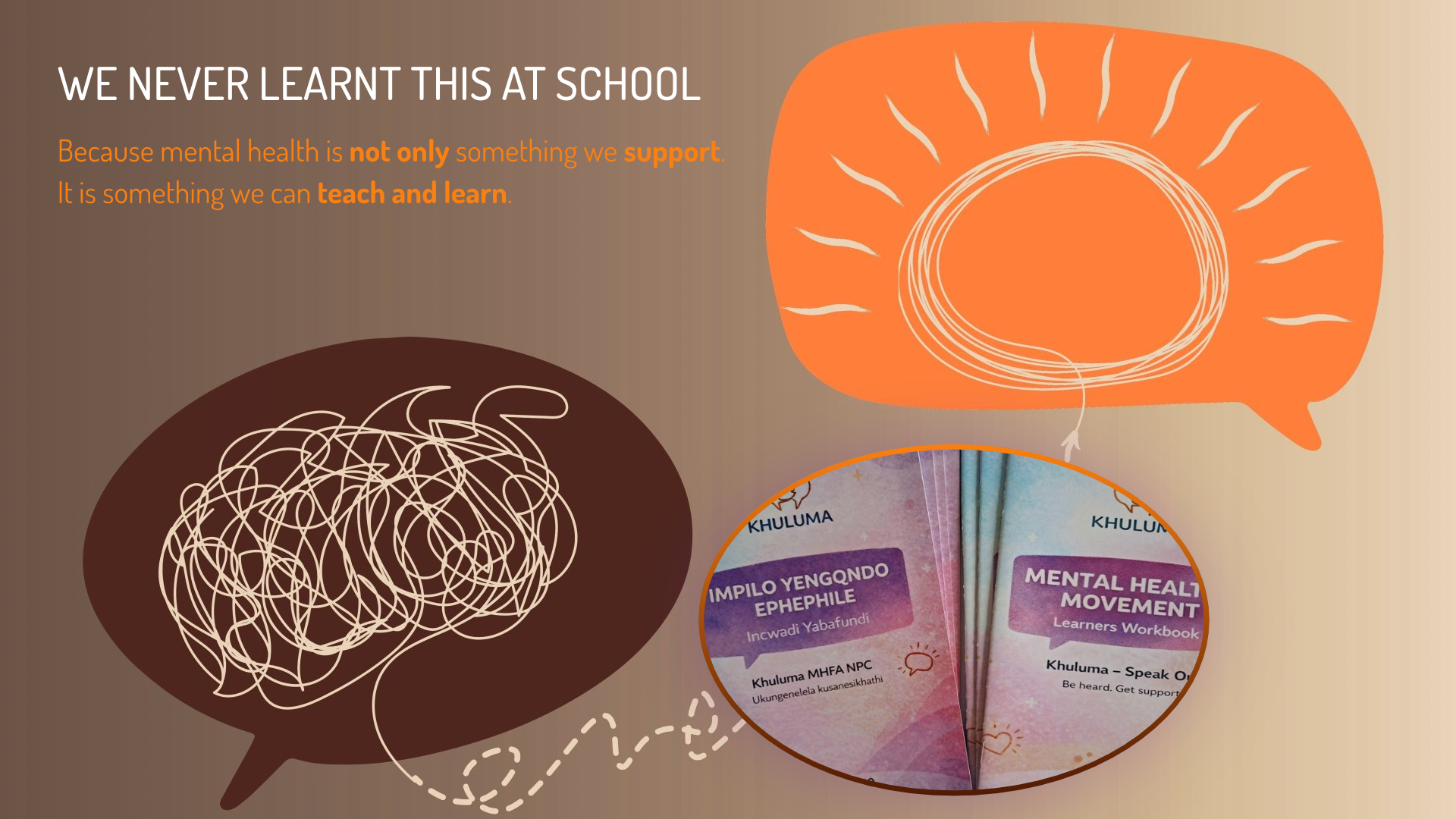
Because mental health is not only something we support. It is something we can teach and learn. What struck us was not what she said about mental health.
- It was what she said about learning.
- She was not asking for counselling.
- She was not talking about mental illness.
- She was not asking for therapy.
- She was saying that nobody had ever taught her what mental health actually is.
And the more we reflected on that conversation, the more we realised that this is one of the biggest challenges facing South Africa today.
Misconception: Mental Health Is Not Mental Illness
One of the most common misconceptions we encounter in schools is the assumption that mental health and mental illness are the same thing. They are not. Everybody has mental health in the same way that everybody has physical health.
Mental health can be strong or struggling.
- It can improve.
- It can deteriorate.
- It can be protected.
- It can be strengthened.
- Mental illness is just one part of the broader mental health picture.
Yet many young people reach high school, and many adults reach parenthood, without ever having had this distinction explained to them.
What If the Problem Is Not Only Support?
Much of the national conversation focuses on access to support:
- More psychologists.
- More counsellors.
- More social workers.
- More clinics.
Those things matter. But what if a significant part of the challenge begins much earlier?
- What if people cannot seek help because they do not understand what they are experiencing?
- What if they have never been taught how stress affects the mind?
- What if they have never learned healthy coping strategies?
- What if nobody has helped them develop the language to describe what they feel?
Before support can be accessed, understanding must exist. And understanding is created through education.
The Classroom Can be a Safe Space For Conversations
When people hear the phrase mental health programme, they often imagine a clinic, an office, or a counselling room.
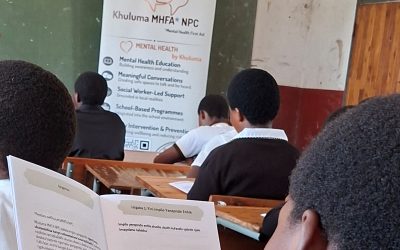
Our experience has been different. We have found some of the most meaningful conversations taking place inside Grade 10 classrooms. Learners discuss:
- stress,
- bullying,
- relationships,
- peer pressure,
- family challenges,
- grief,
- future uncertainty,
- self-worth,
- resilience, and
- help-seeking.
These are not abstract concepts. They are their everyday realities. Our experiences is that when learners are provided with a safe, respectful and non-judgemental environment, they are willing to engage.
In many cases, the challenge is not that young people do not want to talk. The challenge is that nobody has ever shown them how.
Khuluma is Building Mental-Health Literacy and Practical Skills
We have increasingly come to understand that our work is not only about awareness.
- It is not only about advocacy.
- It is not only about support.
- It is also about
When learners participate in our programmes, they learn:
- what mental health is,
- how emotions influence behaviour,
- why resilience matters,
- how healthy relationships are built,
- how to communicate more effectively,
- when to support a friend,
- when to seek help, and
- where that help can be found.
These are life skills. Just as schools teach mathematics, science and languages, we believe there is growing value in teaching mental wellbeing literacy. Not because every learner is experiencing a mental health crisis, but because every learner has mental health.
One Conversation. One Classroom. One Workbook at a Time.
South Africa’s future workforce sits in today’s classrooms.
The Grade 10 learner of today will become tomorrow’s student, entrepreneur, artisan, teacher, manager, parent and leader. If we want more resilient communities, healthier workplaces and stronger families in the future, we cannot wait until young people enter adulthood before discussing mental wellbeing. The conversation needs to start earlier:
- It needs to happen in language that feels natural.
- It needs to happen in spaces that feel safe.
- And it needs to be practical.
That is why Khuluma increasingly sees itself not only as a mental wellbeing organisation, but also as a mental wellbeing education organisation. Because sometimes the most powerful intervention is not treatment.
Sometimes it is simply helping someone understand something they were never taught.
The Conversation Continues
At Khuluma, we believe that every voice matters.
The young mother’s observation reminded us that creating a mentally healthier South Africa is not only about responding to problems. It is also about teaching understanding.
One conversation, One classroom, One workbook, One learner at a time.
Because mental health is not only something we support. It is something we can teach and learn.
About Khuluma MHFA NPC
Khuluma MHFA NPC provides mental health education, awareness, and support programmes to young people across South Africa, empowering them with the skills and confidence to navigate emotional challenges and support one another now and in the years to come.
Media Contact
Khuluma MHFA NPC
Registration No.: 2025/718356/08 | PBO No.: 930090563 | NPO No.: 335-625
Email: Hello@KhulumaMHFA.org.za
Phone: +27 87 353 9800
Website: KhulumaMHFA.org.za
📚 Explore our resource library: 🔗 Downloads
#StudentWellness #TeachersOfSA #YouthEmpowerment #YouthMentalHealth #MentalHealthMatters #PositiveMentalHealth #EveryConversationMatters #KhulumaLetsTalk #MHFA